
My perspective on artificial intelligence in whale tracking.
- Aarvnd Jay
- Feb 13, 2024
- 2 min read

The article "Scaling whale monitoring using deep learning: A human-in-the-loop solution for analyzing aerial datasets" presents a groundbreaking approach that combines machine learning techniques with expert human input to enhance cetacean monitoring efforts. The integration of deep learning algorithms with biologist expertise offers a novel solution for analyzing aerial datasets efficiently and accurately.
One of the key strengths of this study is the human-in-the-loop methodology, which leverages the strengths of both artificial intelligence and human cognition. By involving marine mammal experts in the analysis process, the model benefits from their domain knowledge and ensures high-quality results. This collaborative approach not only enhances the accuracy of whale detection but also allows for better adaptation to new environmental and biological conditions in the imagery.

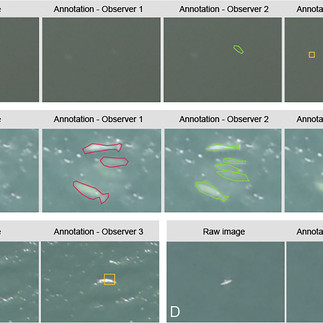
The use of deep learning models, such as land segmentation and cetacean segmentation, demonstrates the versatility and effectiveness of machine learning in processing large volumes of aerial images. The authors employ techniques like Uniform Manifold Approximation and Projection for Dimension Reduction (UMAP) to cluster environmental diversity, enabling the selection of representative images for annotation. This active learning loop strategy optimizes the annotation process and improves the efficiency of the model training.
Furthermore, the study highlights the potential for generalization and scalability of the human-in-the-loop approach to other cetacean species and geographic areas. By developing specialized source models and extending the model's scope to species identification, the researchers suggest a pathway for enhancing cetacean monitoring on a broader scale.
In conclusion, the article underscores the importance of integrating machine learning technologies with expert knowledge in the field of wildlife monitoring. The human-in-the-loop solution presented in this study not only streamlines the analysis of aerial datasets but also paves the way for more effective and efficient conservation strategies. This research contributes significantly to the advancement of machine learning applications in marine mammal research and underscores the value of interdisciplinary collaboration in addressing complex ecological challenges."


Comments